
The veneer of civilization


Then you see kids, good kids from good families. Back home, these kids would help little old ladies across the street. They would also go to Bible study. Yet, they do these horrible things. They’re in the country for a little bit, and it’s like the veneer of civilization peels right off of them.”

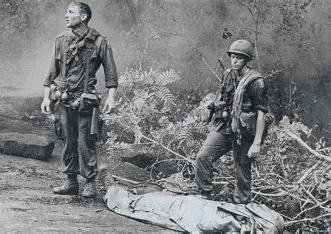
The quote above is from a Vietnam Veteran. He was interviewed for the 10-part documentary The Vietnam War by Ken Burns. He was talking about “acts of war”. In particular, the acts of savagery committed by some American soldiers while serving in Vietnam.

At an average of 90 minutes per episode, completing the series was challenging. But I did, and I have a lot of takeaways. There are hours of battle footage, commentary, and interviews. All the players are involved, including politicians and soldiers from South and North Vietnam, and the enemy. It covers all of the geopolitics involved in Cold War Southeast Asia. Per usual, Burns provides an honest, balanced and unflinching look at one of the darkest chapters in recent history.

The veterans interviewed did the unusual. They talked openly about their experience. They ranged from the reluctant draftee to the hardened veteran. There was also the wide-eyed, eager recruit seeking the honor and glory his father achieved. Finally, there was the everyday guy from Anytown, USA, who felt the call of Patriotism. They all went to the same place, but all came back very different. It wasn’t like the last war, their Dad’s war. And glory was not in the cards.

A lot of men did and saw things that would haunt them. When villages were razed, livestock slaughtered, suspected enemies gunned down, and food supplies destroyed, part of following orders, a lot of soldiers found their moral compass in danger. Some made “deals with the devil” to rationalize their acts. One soldier said, “I will never kill another human, but there’s no limit to how many Vietcong I will waste.” If they are no longer people, then it becomes easier. They are the enemy; they do not matter.

Then some stretched the thin red line even further. Rapes, mass killings of civilians, and excess brutality sometimes occurred. As it says above, it was as if the veneer of civilization had worn off of them.”

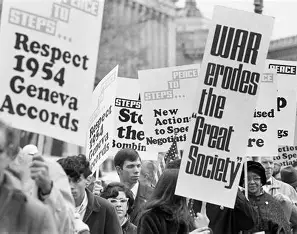
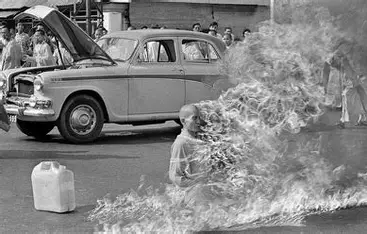
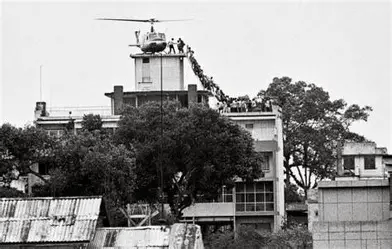
At home, the war had changed people as well. The escalating campaign was enormously controversial. Young people broke ranks with their parents’ beliefs. Students took to the streets and challenged authority figures. Peaceful protest morphed into violence as frustration with a growing conflict grew. Pictures of bombing campaigns and burned children were finding their way into American living rooms, and people were outraged. Some activists decided that violence was justified, and riots and bombings occurred. It culminated when the National Guard opened fire on a crowd at Kent State and killed four. One veteran lamented, “It has gotten so bad we are killing our own at home”. Even after the Saigon airlift of ’73, this country was divided and forever damaged.

When the soldiers returned, there was no ticker tape parade. The hostility towards the war had been directed towards those who had been charged with fighting it. The brave men and women who fought the unpopular war returned from planes and boats. They were unjustly called “baby killers” and were spit upon. These people are still owed the Welcome Home they deserved. But as I have said. Everyone and everything had changed.

What are the rules of civilization? Are they inherent? Are we born to act rationally and be decent to each other? Is it the job of parents to instill the concept of society in us? Is the veneer of civilization so thin that it can be easily worn down? Can we easily descend into barbarism and savagery?

You may not know what it was like to see the political climate of the late 60’s and early 70’s. It isn’t too late. You can still see it. Just turn on your TV. Because it’s still happening, only the target of the outrage is different. Riots, Nazi flags, death threats, mass shootings, shouting, fighting, people just being ugly to each other. So I have to ask; if the veneer of civilization is but a thin covering, what’s underneath?

Understanding Quotes: Beyond the Surface Interpretations

Americans embody a lot of things to a lot of people. One of particular interest to me is the unfinished quote. Is it a testament to laziness? Can I charitably call it brevity? We don’t even care to use complete quotes. We bother to dig into the archives for historical quotes, yet we only use half of it.
A few examples:
The early bird gets the worm“. It means to strive to be early, ahead of others, it speaks to ambition. Yet, that is only half of the quote. The remainder is, “but the second mouse gets the cheese.” It’s actually not a positive, motivational quote at all; it’s a cautionary tale about the downfalls of ambition.
Rome wasn’t built in a day“. On its face, it tells us that great things take time. Sadly, the oft-unused other part is, “but it burned in one.” Suddenly, the lesson becomes a cautionary tale of the temporary nature of things.
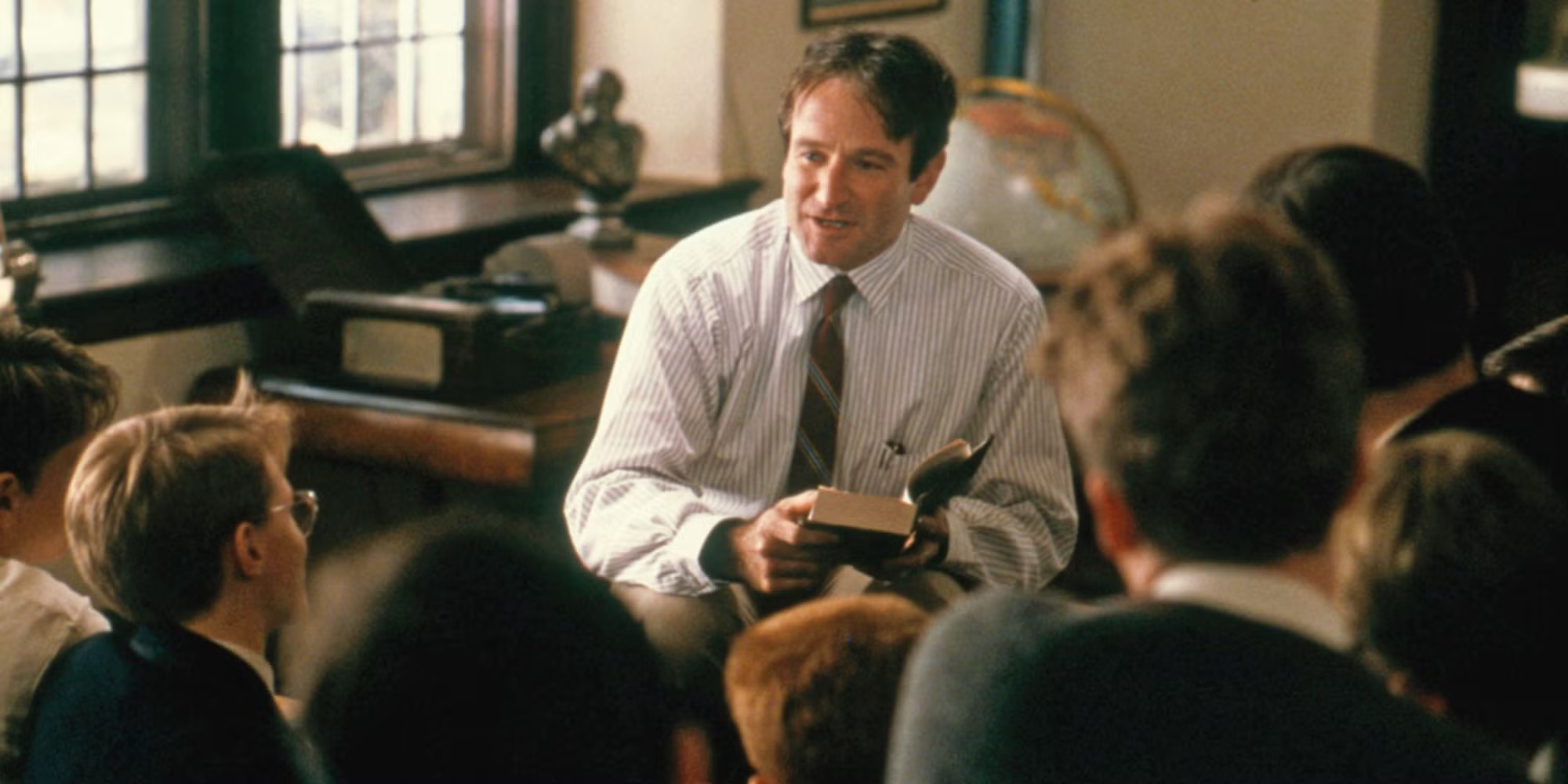
Carpe Diem“. Seize the day, right? I can see Robin Williams in Dead Poets Society, imploring his young, eager pledges to charge forward.

But the full quote is, Carpe diem quam minimum credula postero. “Seize the day, put very little trust in tomorrow”. We use the phrase “Carpe Diem” as a call to go YOLO. However, the phrase actually means to focus on getting things done today. You don’t know what tomorrow will bring.

An eye for an eye.” A call for justice, revenge, an evening of the playing field, right? No, the remainder is, “Only makes the world go blind.” Suddenly, it’s a contradiction to its typical interpretation. Reject vengeance, for it will bring terrible results. Not a call to arms, but a plea for reason and restraint.

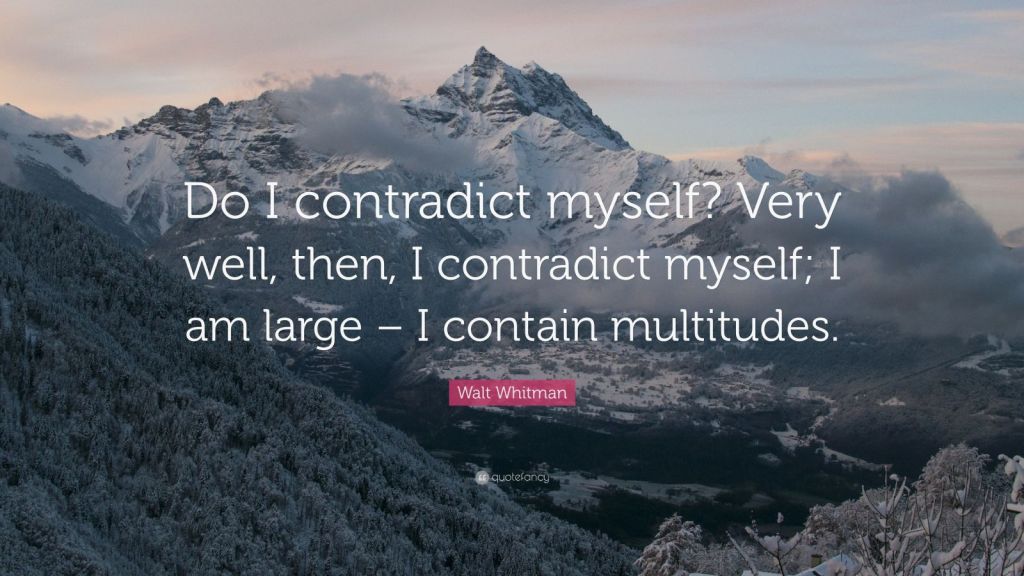
And, the topic dujour, how about “I am large, I contain multitudes“. This is a fragment of a very popular, oft-quoted Walt Whitman quote. It is from his 1855 edition of Leaves of Grass. You will see it on many a Hipster’s tattoo or someone’s FB page. Bob Dylan even named an album after it. Brands, mental health campaigns, and diversity initiatives frequently borrow the phrase to signal the exclusivity of all human complexity. It captures the essence of embracing contradictions and the multifaceted nature of identity.
But the full quote is actually, “Do I contradict myself? Well then,I contradict myself. (I am large/I contain multitudes.) It may be the most quoted line of poetry ever. Some variations:
I am large, I contain multitudes, and every part of me is worthy.”
My contradictions do not weaken me; they make me whole.”
There is room in me for every version of myself.
Consistency is the hobgoblin of little minds; I prefer multitudes.”
I am the poetry of paradox.”

There are more than 30 such valid interpretations, but let’s return to the concept of the incomplete quote. On its face, to say, “I contain multitudes,” implies complexity. A testament to the multifaceted human personality. A testament to the great mind. It is also the tool of a fool. A fool quotes it to project more depth than he actually possesses. When you recognize the hypocrisy of the statement, “Do I contradict myself/ Well then I contradict myself,” you can acknowledge it as a statement of defiance. You can see it not only as hypocrisy but as defiance. This is a rejection, at the time, of the European construct of the infallible, resolute, and focused man. Whitman boldly rejects that anachronism and admits the unpopular and controversial. Man is ultimately fallible and can not only make mistakes. He can change his mind occasionally, even reverse a position if faced with a challenge to his mindset. He is capable of Self-acceptance in the face of inconsistency, and the rejection of binary thinking (good/evil, body/soul, individual/society).

Here are my two cents.
A man can be more than one version of himself.
Being a paradox is not the same as being indecisive as to your position. Is it better to “dig in” when he might be wrong? It’s conducive to growth.
Every part of a man’s being deserves a chance to shine, for every aspect of a man’s personality is worthy.

This subject is of particular importance to me. I have suffered with the consistency of identity forever. I often feel that I present the safest version of myself, that the world can’t take me at Factory Settings. I have deprived myself of true identity by allowing this. At some point, my persona morphed from that of an artist to that of a fake tough guy. I used to draw, paint, read philosophy, and embrace intellectualism through tolerance. One day, or at least it seemed as if it happened in one day, I went the path more traveled. I tried to fit in. I became what I thought the people I was with at the time wanted me to be. I still held on to the artist in me, but he was not shown to many.

At some point, I realized that I had gone too far from my roots. I lost myself in the process. I struggled with it. With my insecurities, I feared exactly what Whitman embraced: hypocrisy. I never considered three facts that, once embraced, would change my life.
1)Within me live a thousand voices, each one is true at one time.
2)Embrace the multitude of personality traits; my true friends will accept me.
3)To deny my opposing character traits is to deny myself and the world of what I have to offer.

I am proud to say that in recent months I have undergone many significant changes. I have come to understand and hold in check the less desirable aspects of myself. I have shifted my negative thinking to being more accepting and loving of myself in all of my weird glory. I have gained confidence that I never knew I had. I care much less what others think of me, I care more now about what I think of me.

I contain multitudes as well. The difference is that I plan to embrace them. Not everyone will be able to handle it. But those I call friends will not only embrace it, but they will welcome it.


MINSKY: The Journey of an Unfulfilled Android

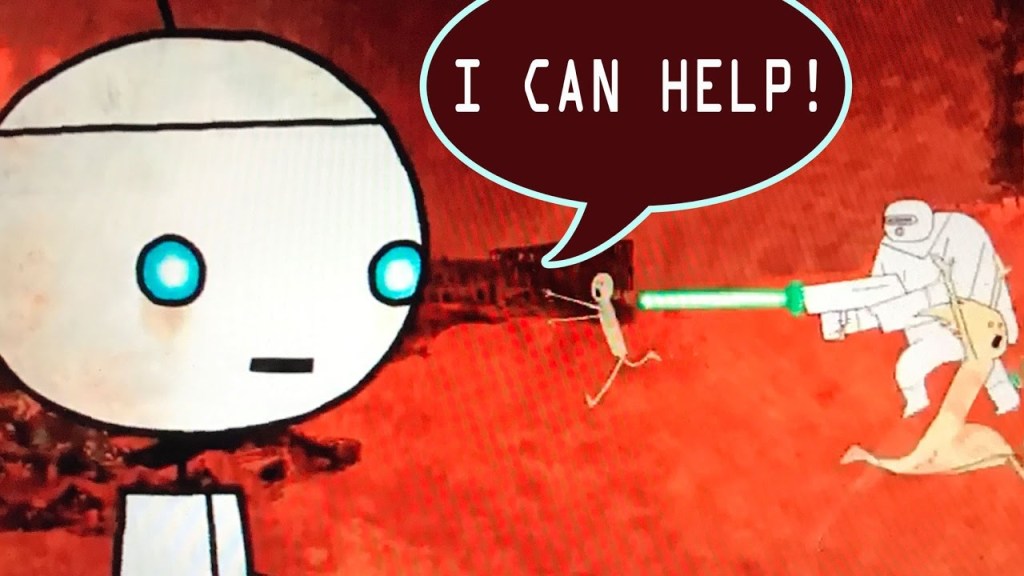
This is my retelling of Fargo, Season 3, Episode 3, in which the backstory of a dead character is examined. Unit MNSKY, or MINSKY, is the creation of a once-promising Science Fiction writer. His career abruptly ended after a publisher took advantage of him. The book, The Planet WYH, was a promising entry in what would be a successful series. It was relegated to obscurity in a box in the floor. The daughter found it after his death and read it. The producers of the show made a bold and brilliant choice. They told the story of MINSKY, the dutiful Robot, through an animated sequence. It is summarized above.
I am so glad they did.

My name is MINSKY, also known as Unit MNSKY. I am a small robot. I exist only in the memories of the readers of my long-forgotten author,and within the pages of a book, carefully tucked away in this tin box under the floorboards of an old house. Forgotten is my story. I’m out of service. My massive quantities of data have been mined, my metal harvested, my work complete.

My spaceship crashed here on planet WYH 2 million years ago. My pilot and friend died soon after impact. I stood over his fading lifeforce, only able to offer my one sentence, “I can help.” As I would painfully discover, I can’t help. All I have are good intentions. In this new world, I hope that is enough. My mission is to walk the earth. I aim to document all that I see.
Alone, I witnessed the creation of matter, the birth of life, the rise and fall of civilizations, and so much more.
As I walked, slowly and deliberately, the path of discovery, I was a mere spectator to the wonders before me. Water creatures left the surf to breathe air and walk. Giant creatures battled for dominance in a world that extinguished them, without acknowledgment for their conquest, with a single asteroid. I wandered through centuries of Ice and barren terrain. I saw villages morph into cities, cities become countries . I witnessed rises and descents, hopeful building of civilizations, and the wanton destruction that followed. I was witness to the creation of remarkable, benevolent scientific inventions that advanced civilization, as well as the destruction of entire civilizations at the hands of terrible weapons created by the same beings. I wandered for almost 2 million years as a mere spectator. The only time beings interacted with me was when I was an unwilling participant. See, I had to stop every century to recharge. While doing so, I was quite vulnerable. Some creatures took the opportunity to attempt to harm me. Once, one of my upper body appendages was torn off as I sat helplessly. I wasn’t offered assistance or kindness; I was taunted and berated. As an Android, I don’t experience emotions such as sadness. But I know what it is; my database prepared me for all things. My intelligence tells me that what I experienced was cruelty, a base emotion displayed by the non-evolved. Cruelty’s antithesis, kindness, was rarely offered and seemed to be in short supply.
That’s not to say that I am not programmed to offer simulated versions of “emotions”, despite being a rational Android. I occasionally extended an appendage, in its literal sense, to beings I encountered in my travels. If I saw someone struggling, I offered an “I can help”. Only to be reminded that, other than being able to enunciate the words, I am unable to act on them. One being was angry at me, upon my failing to help, calling me “useless” and “worthless”. It pleases me that as an Android I am not susceptible to verbal attacks. Besides, I am only an observer here to document and gather intelligence. A one-armed Android tasked with wandering for eternity until my mission is deemed complete.

One day, as I emerged from my recharge slumber, I experienced my first contact with extraterrestrial life since the crash landing as I found myself before several very distinguished members of the Federation of United Planets. After being recognized as the oldest sentient being in the universe I was commended for my longevity and thanked for the massive amounts of information I recorded. I was then told that it was time for me to shut myself down. I nodded in agreement, reached for my head appendage, opened it, located the switch, and shut myself down. My service was done.
I had wandered 2.38 million years. In that vast amount of elapsed time, I had observed and reported as programmed. I had done nothing else.


I traveled, but I did not enjoy.
I observed without the benefit of awe or curiosity.
I wanted to help, but I wasn’t able to.
I recorded my observations, but I didn’t learn from them.
I was done with my mission, but I hadn’t accomplished anything.
I was able to enunciate my desire to help, but I wasn’t able to help.
I existed, but I did not live.
I didn’t retire; I was shut down.
I have no legacy, just an off switch.
I had a long experience, but I didn’t have a life.
I am a sympathetic character, but I have no understanding of what that means.


Jesus, how sad is that?

I love this episode and animated short so much. The art is minimalist yet enthralling. It is both simplistic and maddeningly beautiful. It is poignant yet heartbreaking. It beautifully saddened me. I find myself affected, which is not an easy feat. MINSKY’s journey parallels so many aspects of life that it morphs into an existential meditation on the tragedy of an unfulfilled life.

Life as an observer will never be fulfilling. If you feel like you were put here for a reason, go and pursue it. If you feel like you have a job to do on this planet, take action. Don’t end up like MINSKY.


200 miles

To survive is to be alive, long after the reason to live has died.
Author unknown

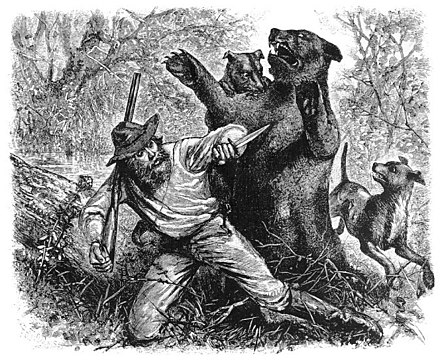
I was thinking recently about Hugh Glass. In 1823, Hugh Glass survived a Grizzly Bear attack. Then he crawled over 200 miles before he finally reached help in South Dakota. It took him weeks. He was the inspiration for the movie The Revenant. Upon reading it, I asked myself if I was capable of such a feat. The answer required little contemplation. No.
I was troubled by what I came up with.

The story of Hugh Glass caused me to explore something I think about frequently, the Will to Live. Late at night, when the demons come, my thoughts turn dark. I debate some horrible shit when I go down the Rabbit hole. When I was sick and on Dialysis, I did my best work. I thought about suicide most seriously. While in this state, I had no regard for anything at all. My life, except for the support of my family and friends, had little to no meaning. The only thing that kept me from doing it was the thought of what it would do to my family. I had ceased to live a purposeful life. I was merely existing. Surviving through my greatest trait. Stubbornness.
I was “surviving to be alive, long after the reason to live had died.”

The above phrase is attributed to the concept developed by German philosopher Arthur Schoppenhaur, supported and furthered by Viktor Frankl. It reflects the concept of an irrational, blind, incessant impulse without knowledge that drives instinctive behaviors. It further suggests that even when life feels meaningless, the act of surviving itself is a form of survival.
Viktor Frankl brilliantly explored this concept through the context of Holocaust survivors in Nazi Germany in Man’s search for Meaning. He observed that survivors often find hope and purpose in their experiences, which can lead to personal growth and resilience.

It’s a powerful thing to ponder. Sadly, I know many people who ponder it as well. I hear them say such things as, “I have no future”, or
“What’s the point?”
“There’s nothing left for me here”,
“I just don’t want to do it anymore.”
Wait, that last one was mine.
It pains me to remember. At the height of my illness, in the darkest of the dark nights, my mind journeyed to hidden places. I can still recall the state I was in. Awash in despair, devoid of interest in the future, desperate for sleep. In those moments, relief was all I could think about. Curled in the fetal position, cocooned in a blanket, I often found myself muttering to noone in particular, “I just don’t want to do it anymore.”
More than once, I said it while sitting on the edge of my bed, .38 Special balanced on my right thigh.
Those were dark days indeed.

My situation has improved since then. I received the gift of an organ transplant 4 years ago. I have made great strides in reclaiming my health, recovering my finances, and rebuilding my life. I have wonderful relationships with family and friends. I am an active Mason, and it is hugely important to me and an integral part of my life. I have a fulfilling social life. I say YES to almost every opportunity now. Having stared down my own mortality, I live like there is no tomorrow. I have a great life.
Still, incredulously, I sometimes go down the Rabbit Hole. I have learned a lot about myself recently, and I am aware that I suffer from depression. It’s not constant or consistent. I just have my moments.
Despite all of the good in my life, my dark half renders me helpless when the darkness comes. I take the negatives in my life and give them more status than they deserve. I find myself emphasizing the significant but manageable negatives in my life to the point of crisis. I then find myself overwhelmed, distraught, and looking for a way out. Which is, of course, just ending it already.
The terror is palpable. As is the frustration when I come out of it. Fortunately.

Here it is. I don’t want to die. I like my life. I may even love it; it depends largely on the day. I am living a purposeful life. The negatives of my life are manageable. Sure, I wish I were better off financially. But good things always happen to me, so why worry about it? I really do desire to have a female companion on this journey. But who knows if I’ll meet her tomorrow? And amazingly, I am doing fine without one. I have a lot to be grateful for, and I am living a blessed life.

So, back to the above quote, and the man who crawled 200 miles to survive, and the question of whether I was capable of such a feat.
I have changed my answer to a firm, resolute MAYBE. What I do know with certainty is that I would never just lie down and die. I would try. My mental health would determine how hard I tried. It would, consequently, decide how many miles I would be able to crawl. If it happens to me on a day when I feel good about myself. A day when I am at peace with who I am. Or a day that I am not consumed by self-deprecating and self-sabotaging behaviors. A day in which I feel in harmony with my resilience. A day when I knowingly wield the sword of inner strength that allowed me overcome two life-threatening diseases. This strength has also helped me face many transformational obstacles.
On those days, 201.
When the darkness comes? I would have leaned against the nearest tree. I would have sighed with relief. I welcomed the inevitable with one last “I can’t do it anymore.”

My mission in life going ahead must be to vanquish the “me” that would give up that easily. But that’s the thing about the darkness. It comes whether I want it to or not. The key for me is to always focus on the purposeful aspects of my life. I want to stay on track with my hope to die a good man. I aim to be a man who left the world a little better than he found it. At the very least, I hope not to make it worse off. I have to learn to consistently look at the good in my life.

Then, and only then, will I end the dichotomy of Living with Meaning vs. merely existing.

Shadow Work

My mind knows all my weak spots, replays failures like favorite songs, questions my worth at midnight, turns memories into weapons. I fight battles no one sees, lose sleep to thoughts that never rest. The hardest war isn’t outside, it’s surviving a brain that refuses to be kind to its own heart.
Ticus Writes

I’m in a somewhat good place overall. I have been working hard on myself. I have been summoning all of my questionable inner resolve to make significant improvements in my life. I have made considerable progress in self-awareness. I am unabashedly accountable about myself and my actions.
I suspect that many men my age simply accept who they are, peccadillo’s and all. It is tempting to think, “the hell with everyone, let them handle me as I am in all my weirdness.’ Me, I’m not willing to go down that road. As a Mason, I believe in the Fraternity’s emphasis on continuous improvement until we advance to another plane of existence. Rough stone to polished. That belief supports my desire to get myself right, even if it culminates with my last day on this planet.

For all of the effort put in, it all goes out the window on days like yesterday. I really spiraled out. The worst part of it is that I saw it coming. Yet, I still self-sabotaged myself. In a very embarrassing and expensive manner.

Last week my good friend and Masonic Brother asked me to do some snow plowing for him. He is away on a short Florida vacation. He is a tremendously hard worker and needs some R & R. He asked me to come along as he managed his only account. It’s a dental practice. He wanted me to get a feel for it. I’ve plowed before, the job seemed easy. I told him I would do it.
That night I had a panic attack. My mind bombarded me with all of the reasons why I can’t do it. How I would damage the truck or some property. The idea of plowing it with cars there suddenly terrified me. It was irrational, it was annoying, and it was typical of what my mind does when I smoke weed. The next day, no longer stoned, I was still a little anxious but more confident.
Good thing, because it snowed the night before.
My anxiety flared. Despite that, I got myself out of the house and did the job. I went to his house, drove the truck to the job, and did a fine job on the lot. I chunked up a bit of grass, even left a few tire prints, but nothing terrible or costly. I felt better about myself and my abilities, but I was still anxious. I knew in my heart that I was about to self-sabotage myself.
As I pulled into his long driveway I realized that I would have to pull the truck in. I had found it backed in. So I searched (panicking the whole time), for a spot to turn around and back in. Against my better judgment, I pulled into a spot. I was immediately stuck. As I tried to get myself out, the truck slid sideways into a previously unnoticed embankment.
I knew that I was screwed. And I knew that it could have been avoided by listening to my better instincts. But they were nowhere to be found. I had done it, the self-fulfilling prophecy of being so afraid of Fucking Up that I do exactly that.
It’s resolved now, but it cost my buddy, who coordinated the removal while driving to Florida, quite a bit. I was so upset about that. I went home and sat in utter despair, beating the ever-loving shit out of myself. All I could come up with was.
“Why do I continue to do things like this?”
“Why do I have such anxiety about something I am able to do?”
“Why did I make that reckless move that caused all of this?”

It was bad. Despite my friend’s reassurance that it wasn’t a big deal, I was in a bad place. For a brief and terrifying moment, I revisited the idea of eating a bullet. I just wanted to end this shit already. Even if 100 people were in my apartment, they couldn’t convince me otherwise. I felt like the biggest fuck-up ever born.
It was at that moment that I decided that I needed to step up my quest for self-improvement.

I discovered an article about Shadow Work. Shadow work involves acknowledging and exploring the hidden parts of ourselves. It helps heal the parts that we reject and repress into our unconscious minds. It involves confronting and integrating these repressed emotions, desires, and traits to foster personal growth and self-awareness. It is rooted in Jungian psychology. In this context, the shadow self represents the darker aspects of our personality that we often avoid. The goal is to help individuals reconnect with and embrace all parts of their identity. As it turns out, there are apps for it.

I spent most of last night reading up on Shadow Work. As a Psychology major in college, I enjoyed the Personality theory of Jung. Jung expanded and broadened the narrow constraints of Freudian personality theory and Shadow work is a worthy extension of his theories.
I am going to give the app a try. I have nothing to lose and everything to gain by doing so. I have to do it.
Because there is no way that I am going to continue to go through the agonizing, self-flagellating, monstrous tearing down of myself that I engaged in yesterday. I simply can’t do it anymore. I know that I am better than this and I owe it to myself to find the way to fix this.

Moving forward

I’ve been in a good place recently. I feel well, my upcoming biopsy is on my mind, but not consuming me. I’ve maintained the weight loss and am getting frequent comments of support. Also, I am rapidly approaching the 12-month milestone of sobriety. It pleases me that I’m not tempted to imbibe despite the high prevalence of alcohol everywhere during the Holiday Season. Additionally, my mental health has been better. In particular, I am struggling less with the self-worth issues that have plagued me.

I really don’t understand why I struggle so with self-worth. Particularly at this stage in my life. I am definitely on the back nine of life. I have nothing to prove to anyone. My children are grown, and by all measures, successful. The worrying never ceases as a parent. However, now that they are grown, my children are a source of comfort, not worry.
My career is over. Any work I undertake going forward will be done at my discretion and on my own terms. The days of worrying about my job are over. Gone with it are the endless attempts at pleasing thankless employers through giving entirely too much of myself. Now, money is about survival.
I have a thriving social life. I actually have more events to attend than time to do them. While most men my age, according to studies, have few friends, I have an abundance.
Things are good because I’m trying to look at things through a different lense.

I have been feeling overwhelmed of late. I continue to ignore my limitations and carry a full calendar. I do too much and then lament how tired I am. It’s because I can’t say no.
As an active Mason, I have the ability to be out as much as I want. There is always something going on. Being known as an active Mason, I get invited to a lot of events. Masonic events are a true joy for me. I truly enjoy the company of my Brothers, some of the best men I have ever met. And Masonry itself, what can I say, I love everything about it. The civility, historical significance, the fraternal atmosphere appeal to my very being. It is hard saying no because everything is a “can’t miss.”
But it takes a toll on me. I get so tired that I need time to recover.

Since my recovery I have been Jim Carrey in Yes Man. I hit the ground running and started to live my life as if living itself were dependent upon saying YES! After spending so much time dealing with being sick and potentially without a future, I began to spend my time enjoying being healthy with the prospect of living a full life. I love saying Yes.
But then I got tired. I began to have difficulty bouncing back from too many nights out and required more rest. Every instinct told me to take a break, that not everything requires me to be there. So I took a small break. That wasn’t the answer. Slowing down is the exact opposite of what I need. If I have to pick one, because I am totally incapable of walking a line down the middle, I have to pick being busy.
I can rest when I’m dead.

What I have come to realize is that being active has been very good for my mental health.

A project

Yesterday I received some good news. I have a project to do. I love the idea of having a project. After all, it’s snowing outside my window.

Ok Bill, what do snow and a project have in common? What is the link in your twisted little mind?
Simple. It’s winter. I hate winter. In the cold, gray days of winter, I battle daily the constant urge to isolate. I feel the need to distance myself from friends and family. I also face the persistent urge to consume illicit substances. The urge to drink, despite having completed 11 months of abstinence from booze, is powerful right now. My thinly veiled control over my Weed consumption is challenged as well. A few puffs at night may have began as a way to calm the chaotic maelstrom I call a brain. But it can easily become a real habit.

In the summer, I am busier than a one-armed paper hanger. In the winter, I have to find ways to stay busy. It is truly the difference between peace and spiraling down the drain of doubt and despair. It’s about motivation. I touched on it in yesterday’s post. I need discipline to find motivation. That’s where projects come in. When I have to complete something I always do. Because the only thing I hate more than boredom is not completing an assigned task.

If you have read me at all, you will know that I am an active Freemason. Masonry is a volunteer organization dedicated to self-improvement and charity. Being a Mason can be exasperating. If you truly love it, you end up dedicating a major portion of your life to it. I must truly love it because I am doing something Masonic all the time. When I’m not, I’m riding Motorcycles or hanging out with friends who are also Masons. I love everything about it.
So much in fact that I want to do more.

The Grand Lodge of MA announced last month that it was offering 25 spots in the 10-month Masonic Leadership Institute. This is a renowned leadership program modified and adapted to the unique challenges and aspects of Freemasonry. I jumped at the opportunity and got my application in early. Masonry is a fraternity steeped in history and tradition. It relies on the consistency of its leaders. They maintain time-honored traditions. Simultaneously, they recognize new technologies and apply them. The fraternity grows and adapts to the changing world around it. It offers the active and enthusiastic Mason an opportunity to improve their skills and develop strategies to lead the fraternity. It is not a secret that the high-profile nature of the program shines a spotlight on the Brothers who enroll. I am sure that many who applied are seeking some measure of recognition in the interest of advancement.
I just want to serve.
In my humble opinion, a Mason should focus on the core tenet of service. Otherwise, they are in it for the wrong reasons.
That is what my application essay was centered around. They must agree because I was accepted.

I now have a project. A project that I cannot wait to explore. My love for Freemasonry exudes from my every pore. To learn more about how to make it better for others will make it better for me as well. I don’t want advancement, I want new opportunities. Opportunities to expand my horizons. Opportunities to meet new people and share experiences. Opportunities to make a difference. Again, if you’ve ever read me, that matters to me.

I love the idea that I can focus on developing and sharpening my skills for the higher calling of service. I embrace the idea of refining my mindset and improving my thinking. Not only do I love it, but I also need it. It may be the one that stands between surviving the winter with my Mental Health intact. The other option is clear. It means fighting the urge to drown my anxieties and insecurities with depressants. This struggle will continue until the days get longer.

Deflection

Saw this on my FB feed today.
Nobody grinds harder than the man who’s tasted failure, pain, rejection, loss, disrespect, loneliness, and heartbreak at a young age.
Use all the pain as fuel
.”
Author unknown.

I was at a function recently and was presented with an award by my peers. It was an amazing gesture of thanks for an event that I had sponsored for a distressed brother. I was honored, but visibly uncomfortable with the public accolades. After the dust had settled, I was talking to a Brother whom I respect greatly. He said, “It’s okay to be recognized, Bill. You do a lot for people.”
I replied that I don’t do things for acknowledgment, I do them because I can.
“It’s because you’ve been through some shit, and you know how it is to be down.”I suppose it’s true. My past comes through when an opportunity to help someone arises.

I know how this sounds. As I write this, I am painfully aware that I am opening myself up to charges of hubris. I swear on all that matters to me that I am not about that. I have reached a unique point in my life. I am really not about me anymore. I like my life as it is, but I’ve gone as far as I can. I’m in a acceptable rut. I have my routine and the things that make me happy. The rest of my time is for my fellow man.

My old life was marked by constant errors in judgment, poor decisions, and struggles in interpersonal relationships. Then came the illness. At the culmination of my illness, I hit the ultimate place of learning: Rock Bottom. From the depths of that pit, I experienced despair and loneliness. I felt hopelessness, dependency, and isolation. I also faced failure, pain, and rejection. The loss and heartbreak were overwhelming. The prospect of an early conclusion to an unfulfilled life terrified me.

My friend Eric recently started dialysis. He told me, “Situations such as this reveal to you who your friends really are.” That resonated with me profoundly. While I did have some very solid support while sick, I dealt with my situation mostly alone. I learned some hard life lessons. I discovered a great deal about who I was. I also realized what I wanted out of life. I vowed that if I were to get better, I would do better. In particular, to channel my own experiences to help others.
Then I got better.

For a few years, I talked about my experience. Maybe too much. I was so happy to be on the right side of the dirt. I shared my story with anyone who wanted to hear it. I believe that everyone has something to offer. Different perspectives inspire new attitudes. Sometimes it only takes a reminder that, no matter how bad you have it, someone has it worse. I utilize the charitable nature of Freemasonry as a tool to help people. Masonic charity is true charity; often done anonymously, and always done without expectation of accolades or anything in return.

Now, in this phase of life, I rarely even talk about my illness. I’m not the sick guy anymore. But I walk with all of the memories of him. The lessons of my past life have changed my perspective. When someone catches my attention, my mind turns to the adage “Be kind. Everyone is fighting a battle you know nothing about.” It keeps me grounded. It’s what causes me to deflect compliments and accolades.

My oldest daughter wrote the following in my Birthday card in July. “Dad, you are the most selfless person I know.” I have been very clear in stating that I don’t like or need compliments. But that one I’ll take as fuel to grind even harder.

Genuine

genu·ine
[ˈdʒɛnjʊɪn]

genuine (adjective)
truly what something is said to be; authentic:“genuine 24-carat gold”

I hear it a lot. “You’re one of a kind”. I know it’s not always a compliment, if it is it’s meant as a backhanded one at best. But I take it for what it’s worth. We’re all unique in one way or another. For better or worse, I suppose. Even the extreme conformists have unique qualities. Sheeple, as I like to refer to them, have something that separates them from the pack. We all have interests, passions, and guilty pleasures. Unfortunately, you have to dig a little harder on some people to find out what makes them different. Personally, I value the differences in people.
I only ask that the world do the same for me. Because for all of my faults, at least I’m genuine. I’m real.

I’ve spent an inordinate amount of my life fighting the compulsion to be what I think the world wants me to be. It’s exhausting. And it’s not for me anymore. I realized recently that I do something embarrassing every day. To be clear, I may be the only one who is embarrassed by it. However, that’s all it takes to send me into a spiral. Those spirals have been devastating to me. A typical fall down the rabbit hole has me questioning my self-worth. It also has me doubting my cognitive abilities for days or even weeks. It has crushed my self-esteem and has often left me wondering how people perceive me. I think it has a little to do with my nightly weed consumption. It is a depressant after all, and what I have described are all symptoms of depression. That’s an easy fix.
But the self-flagellation has to stop.

The answer to how to stop is actually quite simple. Just as one should always accept responsibility and embrace accountability, we should also “Own” our shortcomings. Is it really that simple? Just “Own it”?
Maybe it is.

This is who I am. I am awkward. I say the wrong thing or say too much in general. I sometimes don’t know how to act in situations. My anxiety causes a massive “Murphy’s Law” scenario in which fearing gaffes causes me to do just that. So what would it be like if I removed the worry about the gaffes as a self-fulfilling prophecy?
Bill 2.0. That’s what.

I’m going to lean into it. I am who I am, and I insist on being the genuine me. Social gaffes, saying the wrong thing, the list of things that have made me self-conscious are part of the package. If people don’t get me, I guess it will have to be their problem. If they don’t like me, then they’re missing out on some good stuff. Because, despite all of my awkwardness, I have a lot of good qualities to offer. I need to learn how to showcase them to the world. I’ve always said that you need to look deep to find what makes someone special. Well, then people will have to do the same with me. As my beloved fraternity of Freemasonry espouses, every man needs to shine his light. I live by that credo. So that’s my new philosophy.

Talk about an epiphany.

    Breaking Free from Self-Criticism: A Journey to Self-Acceptance

    I’ve been called a lot of things; heck, I’ve even called myself a few choice terms. When in the throes of self-flagellation, I can be harder on myself than anyone could ever be on me. Unfortunately, I indulge in self-flagellation quite often. Oddly, I have a hard time concluding what I’m upset with myself about. It’s quite confounding.

    I often chalk it up to my anxiety. I have intense Social Anxiety, and the symptoms can closely resemble what we commonly call “neurotic”. Neurotic people overthink. They play back conversations in their head to see if they said something regrettable. They read too much into everything. They think that people are mad at them. Also, they tend to worry about “measuring up”. I am, at times, guilty of all of these.

    Then there are those moments when I know that I’ve done nothing wrong. Overthinkers know things because they have spent an inordinate amount of time thinking about them. Yet I will still feel self-critical in those moments. I recognize that while my conduct wasn’t perfect, I also acknowledge that nobody is. Yet I continue to have this tired conversation over and over with myself. I don’t just hold myself to a high standard; I hold myself to an impossible one. There’s a term for it.
    Moral Perfectionism.
    Moral Perfectionism involves pursuing high ethical standards and moral excellence. This pursuit often leads to anxiety and dissatisfaction. The cause is unrealistic expectations. It can have both positive and negative effects on mental health. A drawback is the fear of making ethical mistakes, which leads to anxiety and avoidance of risks. On the positive side, it can motivate individuals to strive for excellence and ethical behavior.

    I need to be clear. I have no expectations of perfection. There is no such thing as a perfect person. As a Freemason, my objective as a person is to be a little better than I was yesterday. It is NOT about being better than other people. That is my goal. What I am trying to do is make up for my past. I believe that I was, in my past life, a wandering, unaccomplished, and purposeless individual. I regret to add that I have had moments in which I displayed bad character as well. Most people would chalk up the incidents that I am alluding to as “being human”. I am not that kind to myself. I am still beating myself up for everything that a better-adjusted person would have already forgiven themselves for.

    Later in life, I became concerned about my legacy. Along the crooked path of my life, I began to adopt a particular lifestyle. I like to refer to this lifestyle as “the fly on the wall of your funeral” lifestyle. Will the attendees of my funeral remember me well or not? See, I have made my peace with God. I believe my soul is heading North, not South. I have embraced religion and the notion of an afterlife. However, I believe our legacy is of paramount importance. What others remember about us matters. Applying the “fly on your wall” mentality, I live my life with the hope of leaving a positive impression. I aim to do this with everyone I interact with. I aim to ensure they have a good impression of me. Even a one-time interaction should leave them with a positive impression of me in some way. I am quite diligent about this; I actually look for opportunities to be of help or offer kindness. Alas, it is not enough sometimes.

    It’s maddening to know that your expectations are unattainable, but you continue with the charade. The charade lacks parity. Even if I positively affected 20 people, I would still dwell on one less positive incident. It’s truly maddening. It’s known as “Perpetual dissatisfaction”. This is the feeling of inadequacy or dissatisfaction when I feel I haven’t reached my moral goals.

    Even seeing the words “Moral goals” causes me to reassess. I may sync with the characteristics of Moral Perfectionists in some ways. Okay, in many ways. All I’m trying to do is lead a good life. Why isn’t that enough for me? I wake up with a positive attitude. I go out into the world. I capitalize on any opportunities to be an instrument of good. That should be enough. I wake up with a positive attitude. I go out into the world. I capitalize on any opportunities to be an instrument of good. That should be enough.
    But somehow it’s not.

    I need to stop wanting to be perfect. There is no such thing. As I said, it’s maddening. In the world we live in, it is an enormous achievement to simply not be an asshole.

    I should just strive for that.