Raining fire

I’ll never forget it as long as I live. The images flooded the news as I woke on the morning of December 22,1988. They said it was a tragedy. Pan Am Flight 103, a 747 named The Clipper of the Seas, fell from 31,000 feet onto the peaceful Scottish Village of Lockerbie. Fire rained down on entire neighborhoods, killing 11 townspeople, a tragic addendum to the 259 that fell to their death. The debris would cover over 850 square miles. When the FBI, as part of an international coalition of law enforcement, determined that a bomb was the cause of the tragedy, it became the largest crime scene in history.

The news had warned us not to jump to conclusions about Terrorism. I immediately believed that it was. After all, I had been paying attention to the aftermath of the 1983 Marine Barracks bombing, responsible for the deaths of 214 US Marines and 48 French soldiers in Lebanon. I had paid attention to the banter between Ronald Reagan and Moammar Gaddafi (sp). I remembered the night “The Gipper” lit up the city of Tripoli, causing the Libyan leader to never sleep in the same bed again for the rest of his miserable, corrupt life. I knew that US Soldiers and citizens were targets, even valuable fodder for Islamists.

I was beyond outraged at the incident. Terrorism enrages me as a concept. I hate, and I stand by that word, anyone who believes that the slaughter of innocents is acceptable in the advancement of a political or religious agenda. To me, such people are lower than the gunk that slugs wipe off their feet. It sickened me. Unfortunately, my following of the case, as often happens when new, equally or more disturbing news stories happen, led me to lose my fervor.

I am so grateful that Netflix has released The Bombing of Flight 103. I was hesitant to watch it for concerns over getting too worked up. As I said, it was a formative event in my life. I pressed on, and despite the resurfacing of dormant emotions, I was deeply impressed by the layers of the story previously unknown to me.
First, the investigation.
Given the technology at the time, joint investigation teams from 21 countries (21 countries lost citizens in the disaster) were able, through good old-fashioned Police Work, to track a single radio bomb to a single luggage container, the airport in which it was loaded (there were layovers), and eventually the men who did it, along with every detail of their plan. Over 11 years, investigators tirelessly put together a case that would provide a semblance of justice for the beleaguered families of the victims, who had been treated poorly all around. The airline responsible was less than accountable and not suitably cooperative, as well as miserly in their proposed financial settlements. Also, there was widespread dissatisfaction with the lack of communication and the slow pace of the investigative agencies. I could go into more detail, but I’d rather you give it a watch.

The bright spot for me about the series, despite the attention to detail and historical accuracy, was the people of Lockerbie. Lockerbie, Scotland, is a very small town, essentially a village. Nothing had ever occurred there on the scale of the Pan Am crash. Yet when the fireball engulfed an entire neighborhood, they quickly moved from shock to action. They immediately gathered together and searched as far and wide as possible, tasked with the gruesome task of finding survivors. It would soon become apparent that there were none. With this grim reality at the forefront, teams of volunteers fanned out to recover remains and collect anything that, per authorities, “wasn’t growing”. The extent to which they collected potential evidence was only outdone by the sensitivity and respect paid to the deceased. One woman is known to have stayed with a body, still strapped in his seat, overnight and most of the next day so that the body would not be alone. Because she wouldn’t have wanted that for one of their own.
In addition, the people of Lockerbie volunteered to bag and tag all evidence so it could be categorized and, hopefully, identified. What was supposed to be a few weeks’ project evolved into over 6 months. The locals remained vigilant. Most of the clues that led to piecing together the attack came from their efforts. In addition to their attention to detail, I was impressed at the care and respect they showed for the victims’ families. They cleaned items such as books. They laundered certain items in some cases. They even added dried bouquets of local flowers that grew in the fields that had come to be littered with victims. To this end, one of the many family members who would come to visit the quiet village of Lockerbie regularly would report that they came to view the crash site as a place of beauty and peace, not a grim reminder of destruction and death.

The deeply respectful, tireless volunteers of Lockerbie are the lesson of this tragedy. Their kindness and selflessness perfectly offset the crime itself, even though it does little to soften the blow. In the face of hatred, biases, and willful devastation at the hands of soulless animals, the people of Lockerbie answered with love, compassion, and unconditional kindness.

While I will never get the image of the Clipper Maid of the Seas’ decapitated cockpit lying helplessly in a field in Scotland, I am at least now somewhat comforted by where it landed.


Bedside manner and the birth of a blog

Here’s the scene. A renowned oncologist has a stage 4 Melanoma patient as a guest at one of his lectures. She stands before the class. A veritable sea of solemn faces sits behind the life-sucking glow of the laptops before them. The Dr. wants the students to ask his patient the hard questions. In the hopes of improving their future “bedside manner.”
The questions commence. The students are unenthusiastic. They speak in clinical terms. Their faces offer no glimpse of empathy, sympathy, or understanding. They view her with the same enthusiasm as a cadaver. After the third emotionless, flat question the patient turns on them. She challenges their affect. She challenges their humanity. She implores them to see a person, not a patient. In response to her impassioned words, a student flatly asked her how she’s feeling. She then goes off on them as the Dr. watches on in silent agreement.
“How am I feeling?” How are we feeling?” “We’re dying, that’s how we feel!”
“And another thing”, she implored. “When you talk to us try to stop looking so fucking terrified!”
End scene.

The Big C. My kind of show.
Due to my medical history, I cannot help but be very aware of death. I’m not obsessed morbidly. I don’t plan to go anytime soon. Nor, and most important, am I afraid of it. It’s quite simple, actually. I spent so much time sick that it was always there in front of me. So I got to know it.
There are positive takeaways from being mindful of death. It changes how you live, for starters. Facing your own mortality opens the door between “someday I will die” and “when I die”. Suddenly, it becomes a part of your thought process. I think about it from every angle, and I’ve made peace with almost all scenarios. I live with a legacy mindset, always conscious of how I will be remembered. I’m at peace with all of it.
With the exception of a Cancer diagnosis.

That is the appeal of The Big C. It is a brave, unflinching, and honest look at life while facing death. It has it all. Bucket lists, difficult conversations, clinical trials, and experimental medications. Emotions range wildly as we watch Cathy Jamison, played by the always delightful Laura Linney, endure the highs of small victories and the crushing depths of disappointments and setbacks. At the center of it all, she is simply trying to live a normal life, with some mortality-related improvements. I believe it beautifully portrays a loving family dealing with loss. They are slightly dysfunctional and are coping with losing a mother and wife. The true beauty is that the show gives equal treatment to the concerns of both the survivors and the patient.
For the sake of this post, I want to shift focus to the medical aspect. In particular, the challenges of maintaining patient dignity in treatment. That is why I led the story as I did.

I’m very familiar with the patient/Doctor dynamic. In particular, I am very in tune with tone-deaf doctors and Nurses. My experiences have been mostly positive. However, many patients feel like a number or a statistic. They don’t feel like people because Bedside manner isn’t stressed as it once was. How do I know? I was told this by one of my own Doctors.

While hospitalized in 2016 for excessive water retention due to a failed transplant, I was approached by my Nephrologist. He said,
“Bill, you’re going to be here for a few days. If you have the energy, would you do a favor for me?”
“Sure, I’ve got nothing else to do.”
He went on to explain that he had a team of students. By his assessment, they had poor bedside manner. He made quotation fingers as he said “Bedside manner”, so I pressed. He explained that they were very bright and gifted clinically. Still, he was very concerned about their lack of empathy when dealing with patients. I admired that he cared about this, but I was not surprised. After all, he was very good with me.
I asked him what he wanted from me. He explained that he wanted me to tell them my story. Which he knew all about, of course. He said I should not volunteer everything. He wanted me to let them “pull it out of me” due to my natural tendency to overshare. In return, he would give me a certificate for helping out. I was glad to do it.
2 hours later, my hospital bed was surrounded by Medical students. I made it hard on them. I made them pull out of me the things not on their chart. The challenges of being sick for years on end. The financial, marital, parental, and occupational challenges of Chronic illness. I told them as only I could. One of them was in tears at the end, and others were visibly shaken.
My Doctor would later tell me that I was the perfect choice for such a lesson.

Soon after, I was visited by friends. They immediately noticed the new Certificate of Appreciation on my table and asked about it. I shared the story. One of them said, “Brother, you need to start documenting this shit. Write a book, man.” I mentioned that I used to have a blog, maybe it was time to start a new one? The name of it hit me instantly.
Superman can’t find a phone booth. The meaning was simple. I had fight left in me, but I was too weak to find the strength to change into my bullet-proof costume.

This is the same blog, just renamed because eventually I did indeed find my Phone Booth.

People over patients. Bedside manner is everything.


Cynicism and Faith: A Journey of Belief

I was recently asked if I believed in Miracles. 20 years ago, I would have answered this question with a flat, fast NO. Now, after several incidents that defy logical explanation, it’s a firm and steadfast maybe.

A miracle is a powerful thing that defies the physical world and all of the laws of probability. There’s a reason that it requires a panel of very stodgy and high-ranking Catholics to classify anything as a miracle. In that light nothing I’ve witnessed in my life fits the mold.

Perhaps it’s the religious implication of the word. Miracles are largely attributed to a Divine entity. I believe in a higher power, but in the most undefined of ways. I struggle with the notion of an interactive deity. Instead, I chalk belief in such things as miracles up to the human need to explain the unexplainable.

I’m a cynic. I question everything.

I was always uncomfortable owning that. Being a cynic is often mistaken for being challenging or disagreeable. It may be aligned with my trust issues. My favorite saying is, “Trust but verify.” My distrust of people is surely related to my need for proof in matters of belief. Despite having Faith, Hope, and Charity on my right forearm, faith is very elusive to me. The tattoo merely represents hope. With Faith being the struggle that it is, Deity is a constant challenge. Consequently, miracles don’t exist in my world.

Did I mention that I am a fair cynic? I admit to being a quasi-believer at best. I also don’t presume that everything needs an answer. I’ve already admitted my belief. I think that religion is man’s way of explaining what his mind cannot grasp. Prayer plays a particular role in this. I’m not of the same school. I am okay with not knowing the answers to the great mysteries in life. I will continue to question the very meaning of life until my last breath. I will be okay if I never truly understand. I am insignificant, a grain of sand on an eternal beach. I am perfectly content with the possibility that I am not expected to know. Maybe I am supposed to trust the process, as everyone is so fond of saying these days.

As an aside, I constantly question the larger questions in life. I do this not to dismiss the notion of a God, but to come to peace with it. I want, more than anything, to believe. I’m just not there. In the spirit of an inquisitive being, I seek to be wrong. Almost everyone else will retreat to be right in their own minds.

If anyone should believe in miracles, it is me. I have come out on the other side of tragedy and death more than a few times. I have been in a coma, had sepsis, severe accidents, and chronic disease. More than once, I entered a hospital that most thought I wouldn’t leave without a toe tag. I’m still here. Maybe it’s a miracle. But I don’t think I’m important enough, in the grand scheme of things, to warrant one. My life is good and well-intentioned. But the ripples of my actions don’t cross even a duck pond. Instead, I look at my continued presence as the result of good Karma. Everything is energy, after all, and I know I put out good energy into the world. My reward was getting to stick around a little longer.

Living Life Beyond Complaints: A Stoic Perspective

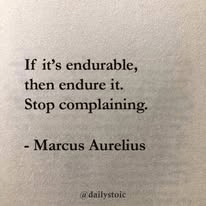
Marcus Aurelius Antoninus, Roman Emperor and Stoic, wrote the above quote over 1800 years ago. Who knew that “Suck it up, buttercup” was a thing so long ago? Are we to surmise that the great Toga-clad Roman society was no more free from complainers than we are today? I suppose this oversimplification fails to do the quote justice. It’s not about complaining, it’s about strength. Marcus Aurelius, as a Stoic Philosopher, believed that the quality of life is determined by how well you face adversity. In short, not everything requires action or a response.

Still, it is refreshing that, as early as 180 A,D complaining was a thing. It tells me it’s not a lovely side effect of a population growing less resilient.

I’m particularly familiar with this quote because I live it. To be clear, I am not special, nor do I want a cookie for having a challenging life. I don’t know anyone whose life isn’t. We all have problems, and it’s not a contest. One may view another’s issues as insignificant compared to one’s own. Still, that does not change the fact that everyone’s problems matter a lot to them. People need to understand this. Some choose to talk about it. Others keep it to themselves, comfortable in the age-old notion that nobody really cares. Or out of not wanting to burden others. And then others, well, they complain.
Not me.

As a person who has consistently dealt with setback after setback, I don’t talk much about my challenges. I was reluctantly “the sick guy” for a long time. Whenever I encountered anyone I knew, there was an inevitable, “How are you feeling?” coming. Please don’t take this as unappreciative. Good words are not guaranteed from everyone. Take them when you can. I simply struggled with the fact that my illness was the most definable aspect of my persona.
The most positive trait I can offer is that I am not a complainer.
I would rather be known as the opposite of a complainer.
Content. Stoic. Strong. Positive. Optimistic.

Have you ever heard someone refer to another as a survivor? “Oh, he/she’s been through so much. What a survivor. I can’t stand that. We are one of 2 things. We are alive, or we are not. Being present enough to be called a survivor means that you are alive. Logic thereby dictates that you have survived. My attitude is that while above the dirt, go out and live while you can.
Life is to be endured.

The mistake we make is to expect life to be fair or happy. The Declaration of Independence offers us the right to pursue happiness, but there is no guarantee of it. Yet many think that happiness itself is guaranteed, and any other outcome is thereby a disappointment. My attitude is that life is a series of obstacles, challenges, disappointments, and pivotal moments. Mixed in with everything entailed in surviving, we have moments of happiness. Brief periods of joy. Those are to be looked forward to because they justify the struggle. Strong people find something to be happy about. Others complain. They fail to recognize that the very breath they use to complain is something for which they should be grateful.

The choice is simple. Endure in silence, or find something in your particular situation to be grateful for. I’m facing another health challenge after only 4 years of relatively good health (my second longest streak). I’m sure that I could find many things to complain about. But I never will. Not only do people not care, but they also don’t like it. They appreciate someone who makes the best out of their situation.

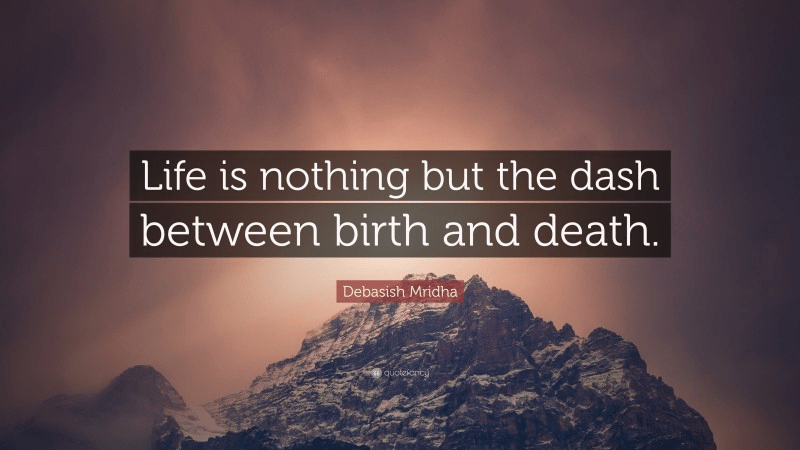
I have a great life. To focus on what I can’t control is just the wrong way to live. Instead, concentrate on what I have in front of me and what lies ahead. Your stone will someday display a date of birth and a date of expiration. The dash, well, that’s everything in between. Live for that.