
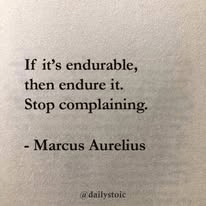
Marcus Aurelius Antoninus, Roman Emperor and Stoic, wrote the above quote over 1800 years ago. Who knew that “Suck it up, buttercup” was a thing so long ago? Are we to surmise that the great Toga-clad Roman society was no more free from complainers than we are today? I suppose this oversimplification fails to do the quote justice. It’s not about complaining, it’s about strength. Marcus Aurelius, as a Stoic Philosopher, believed that the quality of life is determined by how well you face adversity. In short, not everything requires action or a response.
Still, it is refreshing that, as early as 180 A,D complaining was a thing. It tells me it’s not a lovely side effect of a population growing less resilient.
I’m particularly familiar with this quote because I live it. To be clear, I am not special, nor do I want a cookie for having a challenging life. I don’t know anyone whose life isn’t. We all have problems, and it’s not a contest. One may view another’s issues as insignificant compared to one’s own. Still, that does not change the fact that everyone’s problems matter a lot to them. People need to understand this. Some choose to talk about it. Others keep it to themselves, comfortable in the age-old notion that nobody really cares. Or out of not wanting to burden others. And then others, well, they complain.
Not me.
As a person who has consistently dealt with setback after setback, I don’t talk much about my challenges. I was reluctantly “the sick guy” for a long time. Whenever I encountered anyone I knew, there was an inevitable, “How are you feeling?” coming. Please don’t take this as unappreciative. Good words are not guaranteed from everyone. Take them when you can. I simply struggled with the fact that my illness was the most definable aspect of my persona.
The most positive trait I can offer is that I am not a complainer.
I would rather be known as the opposite of a complainer.
Content. Stoic. Strong. Positive. Optimistic.
Have you ever heard someone refer to another as a survivor? “Oh, he/she’s been through so much. What a survivor. I can’t stand that. We are one of 2 things. We are alive, or we are not. Being present enough to be called a survivor means that you are alive. Logic thereby dictates that you have survived. My attitude is that while above the dirt, go out and live while you can.
Life is to be endured.
The mistake we make is to expect life to be fair or happy. The Declaration of Independence offers us the right to pursue happiness, but there is no guarantee of it. Yet many think that happiness itself is guaranteed, and any other outcome is thereby a disappointment. My attitude is that life is a series of obstacles, challenges, disappointments, and pivotal moments. Mixed in with everything entailed in surviving, we have moments of happiness. Brief periods of joy. Those are to be looked forward to because they justify the struggle. Strong people find something to be happy about. Others complain. They fail to recognize that the very breath they use to complain is something for which they should be grateful.
The choice is simple. Endure in silence, or find something in your particular situation to be grateful for. I’m facing another health challenge after only 4 years of relatively good health (my second longest streak). I’m sure that I could find many things to complain about. But I never will. Not only do people not care, but they also don’t like it. They appreciate someone who makes the best out of their situation.
I have a great life. To focus on what I can’t control is just the wrong way to live. Instead, concentrate on what I have in front of me and what lies ahead. Your stone will someday display a date of birth and a date of expiration. The dash, well, that’s everything in between. Live for that.

 The Tao of Bill