
To survive is to be alive, long after the reason to live has died.
Author unknown
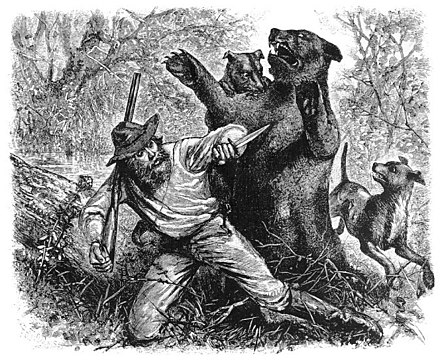
I was thinking recently about Hugh Glass. In 1823, Hugh Glass survived a Grizzly Bear attack. Then he crawled over 200 miles before he finally reached help in South Dakota. It took him weeks. He was the inspiration for the movie The Revenant. Upon reading it, I asked myself if I was capable of such a feat. The answer required little contemplation. No.
I was troubled by what I came up with.
The story of Hugh Glass caused me to explore something I think about frequently, the Will to Live. Late at night, when the demons come, my thoughts turn dark. I debate some horrible shit when I go down the Rabbit hole. When I was sick and on Dialysis, I did my best work. I thought about suicide most seriously. While in this state, I had no regard for anything at all. My life, except for the support of my family and friends, had little to no meaning. The only thing that kept me from doing it was the thought of what it would do to my family. I had ceased to live a purposeful life. I was merely existing. Surviving through my greatest trait. Stubbornness.
I was “surviving to be alive, long after the reason to live had died.”
The above phrase is attributed to the concept developed by German philosopher Arthur Schoppenhaur, supported and furthered by Viktor Frankl. It reflects the concept of an irrational, blind, incessant impulse without knowledge that drives instinctive behaviors. It further suggests that even when life feels meaningless, the act of surviving itself is a form of survival.
Viktor Frankl brilliantly explored this concept through the context of Holocaust survivors in Nazi Germany in Man’s search for Meaning. He observed that survivors often find hope and purpose in their experiences, which can lead to personal growth and resilience.
It’s a powerful thing to ponder. Sadly, I know many people who ponder it as well. I hear them say such things as, “I have no future”, or
“What’s the point?”
“There’s nothing left for me here”,
“I just don’t want to do it anymore.”
Wait, that last one was mine.
It pains me to remember. At the height of my illness, in the darkest of the dark nights, my mind journeyed to hidden places. I can still recall the state I was in. Awash in despair, devoid of interest in the future, desperate for sleep. In those moments, relief was all I could think about. Curled in the fetal position, cocooned in a blanket, I often found myself muttering to noone in particular, “I just don’t want to do it anymore.”
More than once, I said it while sitting on the edge of my bed, .38 Special balanced on my right thigh.
Those were dark days indeed.
My situation has improved since then. I received the gift of an organ transplant 4 years ago. I have made great strides in reclaiming my health, recovering my finances, and rebuilding my life. I have wonderful relationships with family and friends. I am an active Mason, and it is hugely important to me and an integral part of my life. I have a fulfilling social life. I say YES to almost every opportunity now. Having stared down my own mortality, I live like there is no tomorrow. I have a great life.
Still, incredulously, I sometimes go down the Rabbit Hole. I have learned a lot about myself recently, and I am aware that I suffer from depression. It’s not constant or consistent. I just have my moments.
Despite all of the good in my life, my dark half renders me helpless when the darkness comes. I take the negatives in my life and give them more status than they deserve. I find myself emphasizing the significant but manageable negatives in my life to the point of crisis. I then find myself overwhelmed, distraught, and looking for a way out. Which is, of course, just ending it already.
The terror is palpable. As is the frustration when I come out of it. Fortunately.
Here it is. I don’t want to die. I like my life. I may even love it; it depends largely on the day. I am living a purposeful life. The negatives of my life are manageable. Sure, I wish I were better off financially. But good things always happen to me, so why worry about it? I really do desire to have a female companion on this journey. But who knows if I’ll meet her tomorrow? And amazingly, I am doing fine without one. I have a lot to be grateful for, and I am living a blessed life.
So, back to the above quote, and the man who crawled 200 miles to survive, and the question of whether I was capable of such a feat.
I have changed my answer to a firm, resolute MAYBE. What I do know with certainty is that I would never just lie down and die. I would try. My mental health would determine how hard I tried. It would, consequently, decide how many miles I would be able to crawl. If it happens to me on a day when I feel good about myself. A day when I am at peace with who I am. Or a day that I am not consumed by self-deprecating and self-sabotaging behaviors. A day in which I feel in harmony with my resilience. A day when I knowingly wield the sword of inner strength that allowed me overcome two life-threatening diseases. This strength has also helped me face many transformational obstacles.
On those days, 201.
When the darkness comes? I would have leaned against the nearest tree. I would have sighed with relief. I welcomed the inevitable with one last “I can’t do it anymore.”
My mission in life going ahead must be to vanquish the “me” that would give up that easily. But that’s the thing about the darkness. It comes whether I want it to or not. The key for me is to always focus on the purposeful aspects of my life. I want to stay on track with my hope to die a good man. I aim to be a man who left the world a little better than he found it. At the very least, I hope not to make it worse off. I have to learn to consistently look at the good in my life.
Then, and only then, will I end the dichotomy of Living with Meaning vs. merely existing.
 The Tao of Bill
I know you. Your adrenaline would kick in and you would crawl 200 miles repeating,” I am not going out without trying!” You are a NRHS Hornet after all.
LikeLike